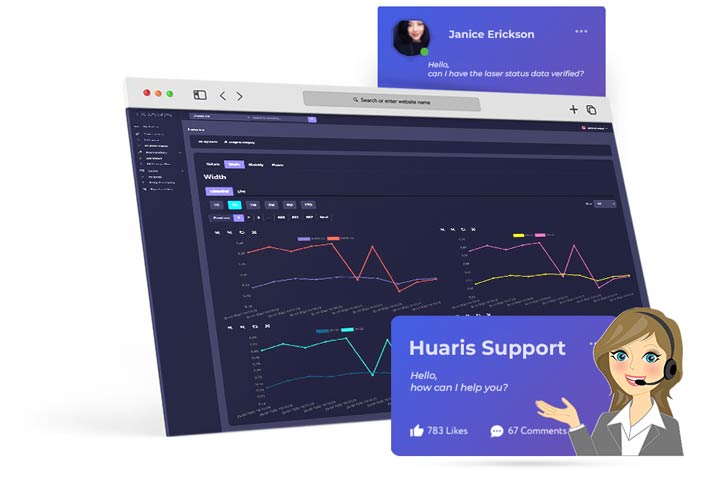





Over 10 years we help companies reach their financial and branding goals. Engitech is a values-driven technology agency dedicated.

Gallery

Contacts

411 University St, Seattle, USA

engitech@oceanthemes.net

+1 -800-456-478-23

// Dedikerte løsninger for forebyggende diagnostikk av laserstrålen

Oppdag Huaris’ produkter innen
laserstråleprofilersystemer

Huaris one and five are portable laser beam profilers with AI-powered remote monitoring
// Kamera for laserstråleprofilering

Huaris One – 1 Mpx laserstråleprofiler

Laserstråleprofiler basert på et 1 megapiksel-kamera for laserdiagnostikk og forebyggende vedlikehold. Vårt selskap er eier av det registrerte varemerket Huaris, som betegner profilerne som brukes til å karakterisere kvaliteten på laserstråler. Vi er produsent av laserstråleprofiler drevet av kunstig intelligens.

// Kamera for laserstråleprofilering

Huaris Five – 5 Mpx laserstråleprofiler

Laserstråleprofiler basert på et 5 megapiksel-kamera for laserdiagnostikk og forebyggende vedlikehold. Vårt selskap er eier av det registrerte varemerket Huaris, som betegner profilerne som brukes til å karakterisere kvaliteten på laserstråler. Vi er produsent av laserstråleprofiler drevet av kunstig intelligens.

// Laserstråleprofiler + nettbrett

Huaris One Mobi – fjernstyrt laserstråleprofileringssett

Huaris One Mobi består av to hovedkomponenter: Huaris One laserstråleprofilometer og et 7″ nettbrett med nødvendig programvare. Ved levering til kunden er hele settet fullt forberedt og konfigurert for drift. Det er bare å koble til strømforsyningen, så kan du begynne å måle.

// Laserstråleprofiler + nettbrett

Huaris Five Mobi

Huaris Five Mobi består av to hovedkomponenter: Huaris Five laserstråleprofilometer og et 7″ nettbrett med nødvendig programvare. Ved levering til kunden er hele settet fullt forberedt og konfigurert for drift. Det er bare å koble til strømforsyningen, så kan du begynne å måle.

// Fjernovervåkingssystem

HLC – Huaris Laser Cloud drevet av AI

Huaris Laser Cloud-systemet er verdens første løsning som bruker maskinlæring til å automatisere diagnostikk av laserstråler. Vi har gjort lasere endelig mulig å administrere eksternt. Huaris Laser Cloud er den første implementeringen av forebyggende vedlikehold i lasersystemer. Systemet er patentbeskyttet.

// Lasereffektmåler

HS2515-U

Den bærbare HS2515-U lasereffektmåleren er et presist og pålitelig instrument for måling av lasereffekt i området fra 10 mW til 15 W. Den kan håndtere ulike bølgelengder, effektnivåer og pulsenergier. Med sin robuste konstruksjon og nøyaktige målinger er HS2515-U lasereffektmåler et essensielt verktøy for fagfolk innen laserteknologi.

«Vi tror på høyteknologi og dens samfunnsmessige påvirkning!»

CEO-Founder of Perspectiva Solutions

// Integrerte løsninger for laserstråleprofilering

Programvare kompatibel med Huaris-systemet

Huaris-familien av profilometre integreres sømløst med Huaris Profiling Desktop Software og Huaris Laser Cloud, og gir et brukervennlig og helhetlig programvareøkosystem tilpasset presis og effektiv profilering. Huaris HS2515-U effektmåler er utstyrt med dedikert programvare: Huaris Power Meter Manager og Huaris Laser Cloud.

// Laserstråleprofiler verdsatt av ingeniører

Huaris-systemet er finalist i Innovation Award

HUARIS-systemet, basert på AI (kunstig intelligens) for forebyggende vedlikehold av lasere. Systemet var finalist i Innovation Award under Laser World of Photonics i München i 2022. Perspectiva Solutions har blitt anerkjent for Huaris-systemet som én av 101 mest innovative maskinlæringsstartups og -selskaper i Polen.

Ifølge Data Magazine fra Storbritannia har vårt selskap blitt anerkjent som en av de mest innovative aktørene i Polen innen maskinlæring!

// Bærbart analyseverktøy for laserstråler

Huaris Mobi – diagnostiske løsninger for laserstråler

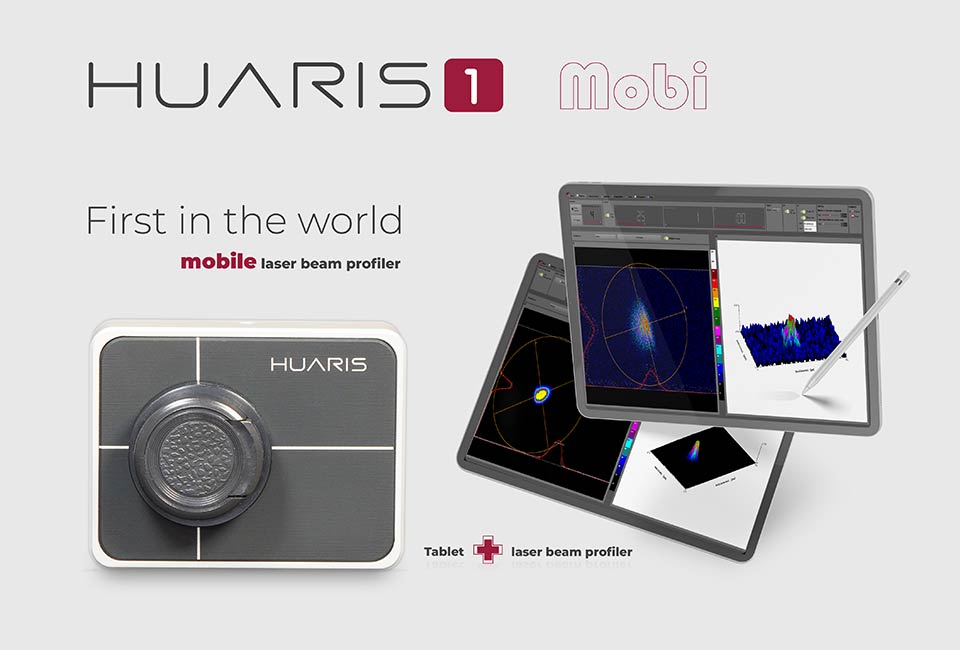
Huaris Mobi er den første mobile laserstråleprofileren. Den gjør det mulig å utføre diagnostiske funksjoner effektivt, samtidig som den sparer plass i laserlaboratorier.

Huaris Mobi er et komplett måleinstrument som består av to komponenter:

  • Huaris One eller Huaris Five laserstråleprofiler

  • 7-tommers nettbrett med forhåndsinstallert, konfigurert og kalibrert programvare

Klar for laserstråleprofilering rett ut av esken

Huaris laserstråleprofiler gjør det mulig å utføre diagnostiske funksjoner effektivt, samtidig som den sparer plass i laserlaboratorier. Produktet er lett og klart til bruk rett ut av esken. Det eliminerer behovet for en standard datamaskin. Alle nødvendige funksjoner for laserdiagnostikk er inkludert i settet. I tillegg sikrer et 7-tommers nettbrett kommunikasjon med laser­skyen.

fjernstyrt laserstråleprofilering

Langtids­overvåking av laserstrålen
forutsier effektivt lasersvikt

// Kunstig intelligens for lasersystemer

Huaris Laser Cloud AI-system for fjernovervåking av laser

  • Drevet av kunstig intelligens

  • Fjernovervåking av strålen

  • Langtids­overvåking av laserstrålens parametere

  • Automatiske alarmer

  • Forslag til forebyggende vedlikeholdstiltak

  • Fjernsupport fra erfarne ingeniører

  • Sentralisert kilde til teknisk informasjon

  • For laser­eiere og vedlikeholdspersonell

Huaris-systemet ble finalist i Innovation Award under Laser World of Photonics i München 2022.

// FAQ laser beam profiling

Read Most Frequent Questions
about laser beam profilers

What is laser beam profile?

A laser beam profile refers to the two-dimensional intensity distribution of a laser beam as it propagates through space. It is a graphical representation of the spatial characteristics of the laser beam, which can be measured using a laser beam profiler. The beam profile can provide information about the shape, size, and power density of the laser beam, as well as its uniformity and symmetry. It is an important parameter to consider in various laser applications, such as laser material processing, medical procedures, and scientific research.

What does a laser beam profile do?

A laser beam profiler is a device that measures the spatial intensity distribution of a laser beam. It provides valuable information about the beam’s size, shape, and power density, which are essential for optimizing laser performance and ensuring that it is suitable for its intended application. By analyzing the beam profile, users can make adjustments to the laser system, such as adjusting the optics, to achieve the desired beam quality and performance.

What is laser profiling?

Laser profiling is the process of measuring and analyzing the spatial characteristics of a laser beam, such as its beam profile, intensity distribution, size, shape, and divergence. Laser profiling is essential for optimizing laser-based systems and applications, such as laser material processing, medical and scientific research, telecommunications, and more. It helps to ensure that the laser beam is focused, collimated, or diverged to the required specifications, and that its properties remain stable and consistent over time. Laser profiling can be performed using various techniques, such as scanning slit, knife-edge, beam profiling cameras, and more.

Why laser beam quality is important?

Laser beam quality is important because it affects the performance of a laser in various applications. A laser beam with high quality has a low divergence angle, which means that the beam can be focused to a smaller spot size, providing higher power density at the target. This makes it possible to process materials more precisely and efficiently, as well as to achieve longer ranges and higher resolution in laser sensing and imaging applications. In addition, a laser beam with high quality is less prone to distortion, which results in a more stable and consistent output power over time, improving the reliability and repeatability of laser-based processes. Therefore, understanding and controlling laser beam quality is crucial for achieving optimal performance in many laser applications.

What is perfect laser beam?

A perfect laser beam refers to a beam of laser light that has ideal characteristics, such as a uniform intensity distribution, a well-defined beam size, and a stable and consistent output power. It also has high spatial and temporal coherence, which means that the phase and frequency of the light wave are the same for all points in the beam over time and space. A perfect laser beam is essential for many laser applications, such as in manufacturing, materials processing, medicine, and scientific research, as it ensures precise and accurate results. Perfect beam has also very high beam pointing stability. Which means that beam does not move in space in time.

How often between laser sessions?

The recommended time between laser sessions depends on the specific laser treatment and individual factors such as skin type and the area being treated. In general, laser treatments for hair removal are typically spaced 4 to 6 weeks apart, while laser treatments for skin rejuvenation may be spaced 2 to 6 weeks apart. However, it’s important to consult with a qualified laser specialist or dermatologist who can provide personalized recommendations based on your unique needs and goals.

How laser beam is produced?

A laser beam is produced by a process called stimulated emission. This process occurs when atoms, molecules, plasma or free electrons called a gain medium are excited to a higher energy level, typically through the input of electrical energy or light. When one of these excited atoms or molecules spontaneously emits a photon, it triggers other excited atoms or molecules to emit photons in phase with the first photon. The result is a cascade of photons that are coherent and monochromatic, meaning they are all in phase with each other and have the same wavelength. These photons bounce back and forth between two mirrors, creating an amplification effect that produces a high-intensity laser beam that can be used for various applications.

What is laser beam profiler?

A laser beam profiler is a device that measures the spatial distribution of a laser beam. It is used to analyze the characteristics of a laser beam such as its size (width), shape, divergence, and uniformity. This information is crucial for optimizing the performance of laser-based systems, such as laser cutting, welding, and drilling. Laser beam profilers typically use imaging sensors, such as cameras or CCD / CMOS arrays, to capture the laser beam profile, and software to analyze and display the data.

Who invented laser beams?

Laser beams were invented by a team of scientists led by Theodore H. Maiman at Hughes Research Laboratories in California in 1960.

What is the difference between laser in-line profiler and laser beam profiler

The main difference between a laser in-line profiler and a laser beam profiler is the way they are used and the type of measurements they make. A laser in-line profiler is typically used in industrial settings to measure the dimensions and shape of objects as they move along a production line. It uses a laser to create a line of light that is projected onto the object, and a camera captures the image of the line or a laser beam spot. The shape of the object can then be determined by analyzing the distortion of the projected line. This type of measurement is useful for ensuring the quality of manufactured parts and detecting defects. On the other hand, a laser beam profiler is used to measure the characteristics of a laser beam itself, such as its shape, intensity, and focus. It may use a camera to capture an image of the laser beam intensity distribution, which is then analyzed to provide information about the beam’s properties. This type of measurement is useful to evaluate the quality of the beam or the laser performance. For more information about the laser beam profiling check our article here (https://www.laser-beam-profile.com/laser-beam-profile-what-is-it/) and for more information about the evaluation of the laser beam quality check this article (https://www.laser-beam-profile.com/laser-beam-quality-evaluation/)

Laser beam profile classification

Laser beam profiles can be classified into several types, including:

  1. Gaussian beam profile: a bell-shaped intensity profile, which is the most common type of laser beam profile.
  2. Top-hat beam profile: a flat-top intensity profile, which is useful for applications where a uniform intensity is required over a certain area.
  3. Super-Gaussian beam profile: a higher order Gaussian beam profile that has a flatter top and steeper edges.
  4. Bessel beam profile: a non-diffracting beam profile that maintains its shape over long distances.
  5. Doughnut beam profile: a beam profile that has a dark spot in the center and a bright ring around it.
  6. Multi-mode beam profile: a beam profile that has multiple intensity peaks, which is common in lasers with large diameter gain media.
  7. Elliptical beam profile: a beam profile that has a non-circular shape, which can occur due to misalignment or aberrations in the laser optics.

The choice of laser beam profile depends on the specific application requirements, such as beam quality, intensity distribution, and focusability.

How beam quality impacts cutting process?

Beam quality is a critical factor that impacts the cutting process in laser cutting machines. A perfect laser beam with high beam quality produces a tightly focused beam with a small spot size, high power density, and low divergence. This allows the laser to cut with precision, speed, and accuracy, resulting in clean and smooth cuts with minimal heat-affected zones (HAZ) and minimal material waste.

In contrast, low beam quality results in a larger spot size, low power density, and high divergence. This leads to slower cutting speeds, inaccurate cuts, and rough edges with a significant HAZ. In addition, low beam quality also requires higher laser power, resulting in increased operating costs and reduced machine lifespan.

Therefore, having high beam quality is essential for achieving optimal cutting performance, reducing operating costs, and improving overall machine efficiency.

How beam quality impacts welding process?

Beam quality can have a significant impact on the welding process. A high-quality laser beam can result in a stable and consistent weld, with a narrow and well-defined weld bead. This is because a high-quality beam will have a small and uniform spot size, which allows for precise control over the heat input and reduces the amount of distortion or warping in the material being welded.

On the other hand, a low-quality beam can result in an inconsistent weld, with a wider and less defined weld bead. This is because a low-quality beam will have a larger and less uniform spot size, which can lead to uneven heating and poor penetration into the material. This can result in a weaker weld with a higher risk of defects such as cracking or porosity.

Therefore, ensuring a high beam quality is crucial for achieving a successful welding process with high-quality and reliable results.

Are laser beams real?

This may be a funny question for some, but it is asked quite often when searching for topics about laser beams.

Yes, laser beams are real. They are a physical phenomenon produced by a device called a laser, which emits coherent, collimated light. Laser beams have a wide range of practical applications in various fields, including medicine, manufacturing, communications, and entertainment.

// Presentation - Huaris laser beam profiler system

Webinar of Huaris System
- Innovation Award Shortlist Quantum category + Sensors

The webinar presenters were the finalists of the Innovation Award of Laser World of Photonics event in Munich this year in the metrology category. Perspectiva Solutions representatives had show how do we address the problem of long downtimes and automatic, remote monitoring of laser systems using artificial intelligence.

Presentation of the Huris system by Perspectiva Solutions for Electro Optics  – Subject :

«Artificial intelligence in predictive maintenance of the laser systems»

Contact Us

We would be grateful for your feedback about the product. Also, if you would like to receive quotation for our product, please use the contact form below.

Our Office in Poland

Perspectiva Solutions
Młyńska 27 St.
22-400 Zamość, Poland

We work on working days CET (Central European Standard Time) in the following hours:

Md. – Fr. 8:00 – 16:00
Sat. – Sun. – Closed

Free Consultation

Huaris inquiries:
Phone inquiries:

Our distributors

    Query for Huaris system: