




Over 10 years we help companies reach their financial and branding goals. Engitech is a values-driven technology agency dedicated.

Gallery

Contacts

411 University St, Seattle, USA

engitech@oceanthemes.net

+1 -800-456-478-23

// Soluzioni dedicate per la diagnostica preventiva del fascio laser

Scopri i prodotti Huaris nel campo
dei sistemi di profilometria del fascio laser

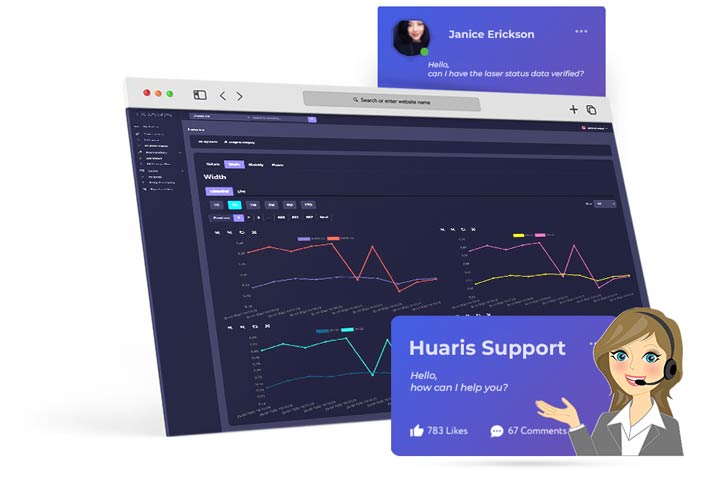
Huaris one and five are portable laser beam profilers with AI-powered remote monitoring
// Telecamera per la profilazione del fascio laser

Huaris One – profilometro del fascio laser da 1 Mpx

Profilometro del fascio laser basato su una telecamera da 1 megapixel per la diagnostica laser e la manutenzione preventiva. La nostra azienda è proprietaria del marchio registrato Huaris, che identifica i profilometri utilizzati per caratterizzare la qualità dei fasci laser. Siamo produttori di profilometri per fasci laser alimentati dall’intelligenza artificiale.

// Telecamera per la profilazione del fascio laser

Huaris Five – profilometro del fascio laser da 5 Mpx

Profilometro del fascio laser basato su una telecamera da 5 megapixel per la diagnostica laser e la manutenzione preventiva. La nostra azienda è proprietaria del marchio registrato Huaris, che identifica i profilometri utilizzati per caratterizzare la qualità dei fasci laser. Siamo produttori di profilometri per fasci laser alimentati dall’intelligenza artificiale.

// Profilometro del fascio laser + tablet

Huaris One Mobi – kit di profilazione remota del fascio laser

Huaris One Mobi è composto da due componenti principali: il profilometro del fascio laser Huaris One e un tablet da 7″ con il software necessario. Al momento della consegna al cliente, l’intero set è completamente preparato e configurato per il funzionamento. Basta collegare l’alimentazione e si può iniziare a misurare.

// Profilometro del fascio laser + tablet

Huaris Five Mobi

Huaris Five Mobi è composto da due componenti principali: il profilometro del fascio laser Huaris Five e un tablet da 7″ con il software necessario. Al momento della consegna al cliente, l’intero set è completamente preparato e configurato per il funzionamento. Basta collegare l’alimentazione e si può iniziare a misurare.

// Sistema di monitoraggio remoto

HLC – Huaris Laser Cloud alimentato da AI

Il sistema Huaris Laser Cloud è la prima soluzione al mondo che utilizza il machine learning per automatizzare la diagnostica dei fasci laser. Abbiamo reso i laser finalmente gestibili da remoto. Huaris Laser Cloud rappresenta la prima implementazione della manutenzione preventiva nei sistemi laser. È protetto da brevetto.

// Misuratore di potenza laser

HS2515-U

Il misuratore di potenza laser portatile HS2515-U è un dispositivo preciso e affidabile utilizzato per misurare la potenza laser nell’intervallo da 10 mW a 15 W. È in grado di gestire diverse lunghezze d’onda, livelli di potenza ed energie di impulso. Grazie alla struttura robusta e alle misurazioni accurate, il misuratore di potenza laser HS2515-U è uno strumento essenziale per i professionisti della tecnologia laser.

“Crediamo nell’alta tecnologia e nel suo impatto sociale!”

CEO-Founder of Perspectiva Solutions

// Soluzioni integrate per la profilazione del fascio laser

Software compatibile con il sistema Huaris

I profilometri della famiglia Huaris si integrano perfettamente con Huaris Profiling Desktop Software e Huaris Laser Cloud, offrendo un ecosistema software completo e intuitivo, progettato per una profilazione precisa ed efficiente. Il misuratore di potenza Huaris HS2515-U è dotato del software dedicato Huaris Power Meter Manager e Huaris Laser Cloud.

// Profilometro del fascio laser apprezzato dagli ingegneri

Il sistema Huaris è finalista di categoria all’Innovation Award

Il sistema HUARIS basato sull’AI (intelligenza artificiale) per la manutenzione preventiva dei laser. Il sistema è finalista di categoria all’Innovation Award del Laser World of Photonics di Monaco, 2022. Perspectiva Solutions è stata riconosciuta per il sistema Huaris come una delle 101 startup e aziende di machine learning più innovative in Polonia.

Secondo la rivista britannica Data Magazine, la nostra azienda è stata riconosciuta come una delle realtà più innovative in Polonia nel campo del machine learning!

// Kit portatile per l’analisi del fascio laser

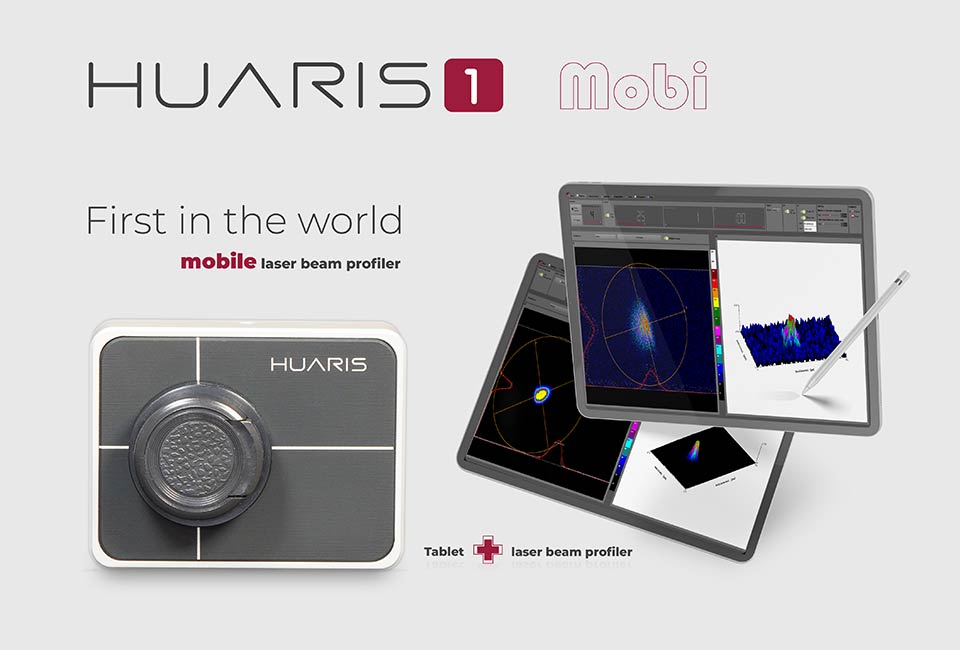
Huaris Mobi – soluzioni diagnostiche per fasci laser

Huaris Mobi è il primo profilometro mobile per fasci laser. Consente di eseguire efficacemente funzioni diagnostiche, risparmiando allo stesso tempo spazio nei laboratori laser.

Huaris Mobi è uno strumento di misura completo composto da due elementi:

  • Profilometro del fascio laser Huaris One o Huaris Five

  • Tablet da 7 pollici con software preinstallato, configurato e calibrato

Pronto per la profilazione del fascio laser appena estratto dalla confezione

Il profilometro del fascio laser Huaris consente di svolgere efficacemente funzioni diagnostiche, risparmiando spazio nei laboratori laser. Il prodotto è leggero e pronto all’uso fin da subito. Evita l’utilizzo di un computer standard. Tutte le funzioni necessarie per la diagnostica laser sono incluse nel kit. Inoltre, un tablet da 7 pollici garantisce la comunicazione con il laser cloud.

profilazione remota del fascio laser

Il monitoraggio a lungo termine del fascio laser
predice efficacemente i guasti del laser

// Intelligenza artificiale per sistemi laser

Sistema Huaris Laser Cloud AI per il monitoraggio remoto dei laser

  • Alimentato dall’intelligenza artificiale

  • Monitoraggio remoto del fascio

  • Monitoraggio a lungo termine dei parametri del fascio laser

  • Allarmi automatici

  • Suggerimenti per azioni di manutenzione preventiva

  • Supporto remoto da parte di ingegneri esperti

  • Fonte centralizzata di informazioni tecniche

  • Per proprietari di laser e personale di manutenzione

Il sistema Huaris è diventato finalista dell’Innovation Award al Laser World of Photonics di Monaco nel 2022.

// FAQ laser beam profiling

Read Most Frequent Questions
about laser beam profilers

What is laser beam profile?

A laser beam profile refers to the two-dimensional intensity distribution of a laser beam as it propagates through space. It is a graphical representation of the spatial characteristics of the laser beam, which can be measured using a laser beam profiler. The beam profile can provide information about the shape, size, and power density of the laser beam, as well as its uniformity and symmetry. It is an important parameter to consider in various laser applications, such as laser material processing, medical procedures, and scientific research.

What does a laser beam profile do?

A laser beam profiler is a device that measures the spatial intensity distribution of a laser beam. It provides valuable information about the beam’s size, shape, and power density, which are essential for optimizing laser performance and ensuring that it is suitable for its intended application. By analyzing the beam profile, users can make adjustments to the laser system, such as adjusting the optics, to achieve the desired beam quality and performance.

What is laser profiling?

Laser profiling is the process of measuring and analyzing the spatial characteristics of a laser beam, such as its beam profile, intensity distribution, size, shape, and divergence. Laser profiling is essential for optimizing laser-based systems and applications, such as laser material processing, medical and scientific research, telecommunications, and more. It helps to ensure that the laser beam is focused, collimated, or diverged to the required specifications, and that its properties remain stable and consistent over time. Laser profiling can be performed using various techniques, such as scanning slit, knife-edge, beam profiling cameras, and more.

Why laser beam quality is important?

Laser beam quality is important because it affects the performance of a laser in various applications. A laser beam with high quality has a low divergence angle, which means that the beam can be focused to a smaller spot size, providing higher power density at the target. This makes it possible to process materials more precisely and efficiently, as well as to achieve longer ranges and higher resolution in laser sensing and imaging applications. In addition, a laser beam with high quality is less prone to distortion, which results in a more stable and consistent output power over time, improving the reliability and repeatability of laser-based processes. Therefore, understanding and controlling laser beam quality is crucial for achieving optimal performance in many laser applications.

What is perfect laser beam?

A perfect laser beam refers to a beam of laser light that has ideal characteristics, such as a uniform intensity distribution, a well-defined beam size, and a stable and consistent output power. It also has high spatial and temporal coherence, which means that the phase and frequency of the light wave are the same for all points in the beam over time and space. A perfect laser beam is essential for many laser applications, such as in manufacturing, materials processing, medicine, and scientific research, as it ensures precise and accurate results. Perfect beam has also very high beam pointing stability. Which means that beam does not move in space in time.

How often between laser sessions?

The recommended time between laser sessions depends on the specific laser treatment and individual factors such as skin type and the area being treated. In general, laser treatments for hair removal are typically spaced 4 to 6 weeks apart, while laser treatments for skin rejuvenation may be spaced 2 to 6 weeks apart. However, it’s important to consult with a qualified laser specialist or dermatologist who can provide personalized recommendations based on your unique needs and goals.

How laser beam is produced?

A laser beam is produced by a process called stimulated emission. This process occurs when atoms, molecules, plasma or free electrons called a gain medium are excited to a higher energy level, typically through the input of electrical energy or light. When one of these excited atoms or molecules spontaneously emits a photon, it triggers other excited atoms or molecules to emit photons in phase with the first photon. The result is a cascade of photons that are coherent and monochromatic, meaning they are all in phase with each other and have the same wavelength. These photons bounce back and forth between two mirrors, creating an amplification effect that produces a high-intensity laser beam that can be used for various applications.

What is laser beam profiler?

A laser beam profiler is a device that measures the spatial distribution of a laser beam. It is used to analyze the characteristics of a laser beam such as its size (width), shape, divergence, and uniformity. This information is crucial for optimizing the performance of laser-based systems, such as laser cutting, welding, and drilling. Laser beam profilers typically use imaging sensors, such as cameras or CCD / CMOS arrays, to capture the laser beam profile, and software to analyze and display the data.

Who invented laser beams?

Laser beams were invented by a team of scientists led by Theodore H. Maiman at Hughes Research Laboratories in California in 1960.

What is the difference between laser in-line profiler and laser beam profiler

The main difference between a laser in-line profiler and a laser beam profiler is the way they are used and the type of measurements they make. A laser in-line profiler is typically used in industrial settings to measure the dimensions and shape of objects as they move along a production line. It uses a laser to create a line of light that is projected onto the object, and a camera captures the image of the line or a laser beam spot. The shape of the object can then be determined by analyzing the distortion of the projected line. This type of measurement is useful for ensuring the quality of manufactured parts and detecting defects. On the other hand, a laser beam profiler is used to measure the characteristics of a laser beam itself, such as its shape, intensity, and focus. It may use a camera to capture an image of the laser beam intensity distribution, which is then analyzed to provide information about the beam’s properties. This type of measurement is useful to evaluate the quality of the beam or the laser performance. For more information about the laser beam profiling check our article here (https://www.laser-beam-profile.com/laser-beam-profile-what-is-it/) and for more information about the evaluation of the laser beam quality check this article (https://www.laser-beam-profile.com/laser-beam-quality-evaluation/)

Laser beam profile classification

Laser beam profiles can be classified into several types, including:

  1. Gaussian beam profile: a bell-shaped intensity profile, which is the most common type of laser beam profile.
  2. Top-hat beam profile: a flat-top intensity profile, which is useful for applications where a uniform intensity is required over a certain area.
  3. Super-Gaussian beam profile: a higher order Gaussian beam profile that has a flatter top and steeper edges.
  4. Bessel beam profile: a non-diffracting beam profile that maintains its shape over long distances.
  5. Doughnut beam profile: a beam profile that has a dark spot in the center and a bright ring around it.
  6. Multi-mode beam profile: a beam profile that has multiple intensity peaks, which is common in lasers with large diameter gain media.
  7. Elliptical beam profile: a beam profile that has a non-circular shape, which can occur due to misalignment or aberrations in the laser optics.

The choice of laser beam profile depends on the specific application requirements, such as beam quality, intensity distribution, and focusability.

How beam quality impacts cutting process?

Beam quality is a critical factor that impacts the cutting process in laser cutting machines. A perfect laser beam with high beam quality produces a tightly focused beam with a small spot size, high power density, and low divergence. This allows the laser to cut with precision, speed, and accuracy, resulting in clean and smooth cuts with minimal heat-affected zones (HAZ) and minimal material waste.

In contrast, low beam quality results in a larger spot size, low power density, and high divergence. This leads to slower cutting speeds, inaccurate cuts, and rough edges with a significant HAZ. In addition, low beam quality also requires higher laser power, resulting in increased operating costs and reduced machine lifespan.

Therefore, having high beam quality is essential for achieving optimal cutting performance, reducing operating costs, and improving overall machine efficiency.

How beam quality impacts welding process?

Beam quality can have a significant impact on the welding process. A high-quality laser beam can result in a stable and consistent weld, with a narrow and well-defined weld bead. This is because a high-quality beam will have a small and uniform spot size, which allows for precise control over the heat input and reduces the amount of distortion or warping in the material being welded.

On the other hand, a low-quality beam can result in an inconsistent weld, with a wider and less defined weld bead. This is because a low-quality beam will have a larger and less uniform spot size, which can lead to uneven heating and poor penetration into the material. This can result in a weaker weld with a higher risk of defects such as cracking or porosity.

Therefore, ensuring a high beam quality is crucial for achieving a successful welding process with high-quality and reliable results.

Are laser beams real?

This may be a funny question for some, but it is asked quite often when searching for topics about laser beams.

Yes, laser beams are real. They are a physical phenomenon produced by a device called a laser, which emits coherent, collimated light. Laser beams have a wide range of practical applications in various fields, including medicine, manufacturing, communications, and entertainment.

// Presentation - Huaris laser beam profiler system

Webinar of Huaris System
- Innovation Award Shortlist Quantum category + Sensors

The webinar presenters were the finalists of the Innovation Award of Laser World of Photonics event in Munich this year in the metrology category. Perspectiva Solutions representatives had show how do we address the problem of long downtimes and automatic, remote monitoring of laser systems using artificial intelligence.

Presentation of the Huris system by Perspectiva Solutions for Electro Optics  – Subject :

“Artificial intelligence in predictive maintenance of the laser systems”

Contact Us

We would be grateful for your feedback about the product. Also, if you would like to receive quotation for our product, please use the contact form below.

Our Office in Poland

Perspectiva Solutions
Młyńska 27 St.
22-400 Zamość, Poland

We work on working days CET (Central European Standard Time) in the following hours:

Md. – Fr. 8:00 – 16:00
Sat. – Sun. – Closed

Free Consultation

Huaris inquiries:
Phone inquiries:

Our distributors

    Query for Huaris system: