




Over 10 years we help companies reach their financial and branding goals. Engitech is a values-driven technology agency dedicated.

Gallery

Contacts

411 University St, Seattle, USA

engitech@oceanthemes.net

+1 -800-456-478-23

// Soluciones dedicadas para el diagnóstico preventivo del haz láser

Descubra los productos de Huaris en el campo
de los sistemas de perfiladores de haz láser

Huaris one and five are portable laser beam profilers with AI-powered remote monitoring
// Cámara para perfilado de haz láser

Huaris One - perfilador de haz láser de 1 Mpx

Perfilador de haz láser basado en una cámara de 1 megapíxel para diagnóstico láser y mantenimiento preventivo. Nuestra empresa es propietaria de la marca registrada Huaris, que identifica los perfiladores utilizados para caracterizar la calidad de los haces láser. Somos fabricantes de perfiladores de haz láser impulsados por inteligencia artificial.

// Cámara para perfilado de haz láser

Huaris Five - perfilador de haz láser de 5 Mpx

Perfilador de haz láser basado en una cámara de 5 megapíxeles para diagnóstico láser y mantenimiento preventivo. Nuestra empresa es propietaria de la marca registrada Huaris, que identifica los perfiladores utilizados para caracterizar la calidad de los haces láser. Somos fabricantes de perfiladores de haz láser impulsados por inteligencia artificial.

// Perfilador de haz láser + tableta

Huaris One Mobi - kit de perfilador de haz láser remoto

Huaris One Mobi consta de dos componentes principales: el perfilómetro de haz láser Huaris One y una tableta de 7″ con el software necesario. En el momento de la entrega del producto al cliente, todo el conjunto está completamente preparado y configurado para su funcionamiento. Basta con conectar la alimentación y se puede comenzar a medir.

// Perfilador de haz láser + tableta

Huaris Five Mobi

Huaris Five Mobi consta de dos componentes principales: el perfilómetro de haz láser Huaris Five y una tableta de 7″ con el software necesario. En el momento de la entrega del producto al cliente, todo el conjunto está completamente preparado y configurado para su funcionamiento. Basta con conectar la alimentación y se puede comenzar a medir.

// Sistema de monitorización remota

HLC - Huaris Laser Cloud impulsado por IA

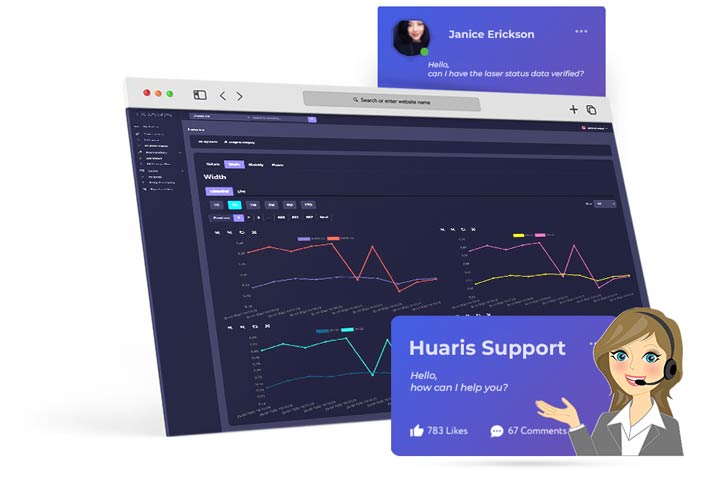
El sistema Huaris Laser Cloud es la primera solución en el mundo que utiliza aprendizaje automático para automatizar el diagnóstico de haces láser. Hemos hecho que los láseres sean finalmente gestionables de forma remota. Huaris Laser Cloud es la primera implementación de mantenimiento preventivo en sistemas láser. Está protegido por patente.

// Medidor de potencia láser

HS2515-U

El medidor de potencia láser portátil HS2515-U es un dispositivo preciso y fiable utilizado para medir la potencia láser en el rango de 10 mW a 15 W. Puede manejar diferentes longitudes de onda, niveles de potencia y energías de pulso. Gracias a su construcción robusta y a sus mediciones precisas, el medidor de potencia láser HS2515-U es una herramienta esencial para los profesionales de la tecnología láser.

«¡Creemos en la alta tecnología y su impacto social!»

CEO-Founder of Perspectiva Solutions

// Soluciones integradas para el perfilado de haz láser

Software compatible con el sistema Huaris

Los perfiladores de la familia Huaris se integran perfectamente con el software de escritorio Huaris Profiling y con Huaris Laser Cloud, proporcionando un ecosistema de software completo y fácil de usar, diseñado para un perfilado preciso y eficiente. El medidor de potencia Huaris HS2515-U está equipado con el software dedicado Huaris Power Meter Manager y Huaris Laser Cloud.

// Perfilador de haz láser apreciado por ingenieros

El sistema Huaris es finalista en la categoría del Innovation Award

El sistema HUARIS basado en IA (inteligencia artificial) para el mantenimiento preventivo de láseres. El sistema es finalista de categoría en el Innovation Award en el evento Laser World of Photonics en Múnich, 2022. Perspectiva Solutions ha sido reconocida por el sistema Huaris como una de las 101 startups y empresas de aprendizaje automático más innovadoras de Polonia.

Según Data Magazine del Reino Unido, nuestra empresa ha sido reconocida como una de las entidades más innovadoras de Polonia en el campo del aprendizaje automático.

// Kit portátil de análisis de haz láser

Huaris Mobi - soluciones de diagnóstico de haz láser

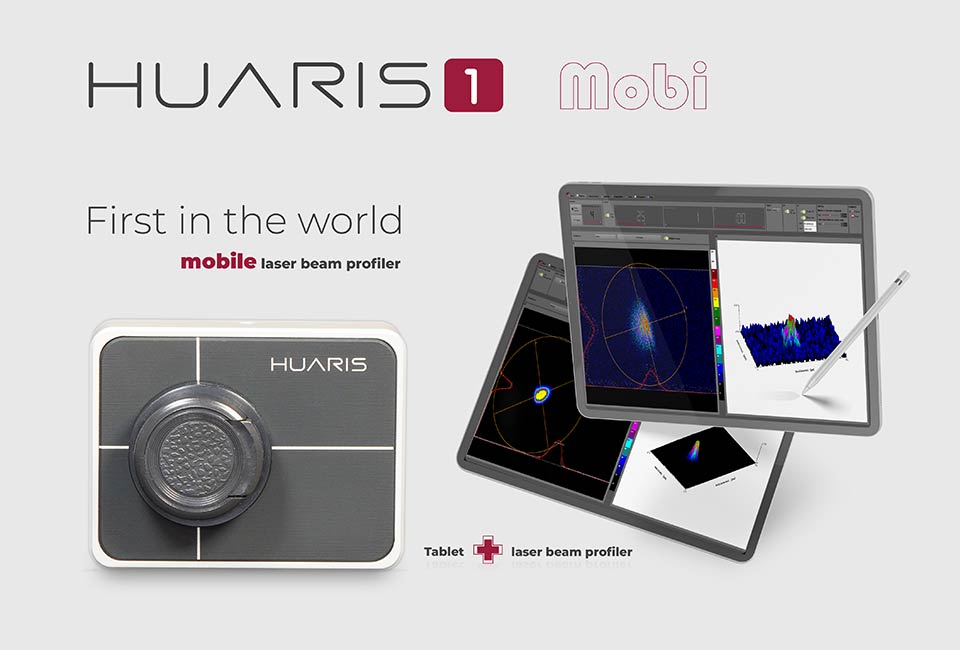
Huaris Mobi es el primer perfilador de haz láser móvil. Permite realizar funciones de diagnóstico de forma eficaz y, al mismo tiempo, ahorra espacio en los laboratorios láser.

Huaris Mobi es un instrumento de medición completo que consta de dos componentes:

  • Perfilador de haz láser Huaris One o Huaris Five,

  • Tableta de 7 pulgadas con software preinstalado, configurado y calibrado.

Listo para el perfilado de haz láser directamente al sacarlo de la caja

El perfilador de haz láser Huaris permite realizar funciones de diagnóstico de manera eficaz, ahorrando espacio en los laboratorios láser. El producto es ligero y está listo para funcionar desde el primer momento. Evita el uso de un ordenador estándar. Todas las funciones necesarias para el diagnóstico láser están incluidas en el kit. Además, una tableta de 7 pulgadas garantiza la comunicación con la nube láser.

perfilado remoto de haz láser

La monitorización a largo plazo del haz láser
predice eficazmente fallos del láser

// Inteligencia artificial para sistemas láser

Sistema Huaris Laser Cloud con IA para la monitorización remota de láseres

  • Impulsado por inteligencia artificial

  • Monitorización remota del haz

  • Monitorización a largo plazo de los parámetros del haz láser

  • Alarmas automáticas

  • Sugerencias de acciones de mantenimiento preventivo

  • Soporte remoto de ingenieros experimentados

  • Fuente centralizada de información técnica

  • Para propietarios de láseres y personal de mantenimiento

El sistema Huaris se ha convertido en finalista del Innovation Award en el evento Laser World of Photonics en Múnich 2022.

// FAQ laser beam profiling

Read Most Frequent Questions
about laser beam profilers

What is laser beam profile?

A laser beam profile refers to the two-dimensional intensity distribution of a laser beam as it propagates through space. It is a graphical representation of the spatial characteristics of the laser beam, which can be measured using a laser beam profiler. The beam profile can provide information about the shape, size, and power density of the laser beam, as well as its uniformity and symmetry. It is an important parameter to consider in various laser applications, such as laser material processing, medical procedures, and scientific research.

What does a laser beam profile do?

A laser beam profiler is a device that measures the spatial intensity distribution of a laser beam. It provides valuable information about the beam’s size, shape, and power density, which are essential for optimizing laser performance and ensuring that it is suitable for its intended application. By analyzing the beam profile, users can make adjustments to the laser system, such as adjusting the optics, to achieve the desired beam quality and performance.

What is laser profiling?

Laser profiling is the process of measuring and analyzing the spatial characteristics of a laser beam, such as its beam profile, intensity distribution, size, shape, and divergence. Laser profiling is essential for optimizing laser-based systems and applications, such as laser material processing, medical and scientific research, telecommunications, and more. It helps to ensure that the laser beam is focused, collimated, or diverged to the required specifications, and that its properties remain stable and consistent over time. Laser profiling can be performed using various techniques, such as scanning slit, knife-edge, beam profiling cameras, and more.

Why laser beam quality is important?

Laser beam quality is important because it affects the performance of a laser in various applications. A laser beam with high quality has a low divergence angle, which means that the beam can be focused to a smaller spot size, providing higher power density at the target. This makes it possible to process materials more precisely and efficiently, as well as to achieve longer ranges and higher resolution in laser sensing and imaging applications. In addition, a laser beam with high quality is less prone to distortion, which results in a more stable and consistent output power over time, improving the reliability and repeatability of laser-based processes. Therefore, understanding and controlling laser beam quality is crucial for achieving optimal performance in many laser applications.

What is perfect laser beam?

A perfect laser beam refers to a beam of laser light that has ideal characteristics, such as a uniform intensity distribution, a well-defined beam size, and a stable and consistent output power. It also has high spatial and temporal coherence, which means that the phase and frequency of the light wave are the same for all points in the beam over time and space. A perfect laser beam is essential for many laser applications, such as in manufacturing, materials processing, medicine, and scientific research, as it ensures precise and accurate results. Perfect beam has also very high beam pointing stability. Which means that beam does not move in space in time.

How often between laser sessions?

The recommended time between laser sessions depends on the specific laser treatment and individual factors such as skin type and the area being treated. In general, laser treatments for hair removal are typically spaced 4 to 6 weeks apart, while laser treatments for skin rejuvenation may be spaced 2 to 6 weeks apart. However, it’s important to consult with a qualified laser specialist or dermatologist who can provide personalized recommendations based on your unique needs and goals.

How laser beam is produced?

A laser beam is produced by a process called stimulated emission. This process occurs when atoms, molecules, plasma or free electrons called a gain medium are excited to a higher energy level, typically through the input of electrical energy or light. When one of these excited atoms or molecules spontaneously emits a photon, it triggers other excited atoms or molecules to emit photons in phase with the first photon. The result is a cascade of photons that are coherent and monochromatic, meaning they are all in phase with each other and have the same wavelength. These photons bounce back and forth between two mirrors, creating an amplification effect that produces a high-intensity laser beam that can be used for various applications.

What is laser beam profiler?

A laser beam profiler is a device that measures the spatial distribution of a laser beam. It is used to analyze the characteristics of a laser beam such as its size (width), shape, divergence, and uniformity. This information is crucial for optimizing the performance of laser-based systems, such as laser cutting, welding, and drilling. Laser beam profilers typically use imaging sensors, such as cameras or CCD / CMOS arrays, to capture the laser beam profile, and software to analyze and display the data.

Who invented laser beams?

Laser beams were invented by a team of scientists led by Theodore H. Maiman at Hughes Research Laboratories in California in 1960.

What is the difference between laser in-line profiler and laser beam profiler

The main difference between a laser in-line profiler and a laser beam profiler is the way they are used and the type of measurements they make. A laser in-line profiler is typically used in industrial settings to measure the dimensions and shape of objects as they move along a production line. It uses a laser to create a line of light that is projected onto the object, and a camera captures the image of the line or a laser beam spot. The shape of the object can then be determined by analyzing the distortion of the projected line. This type of measurement is useful for ensuring the quality of manufactured parts and detecting defects. On the other hand, a laser beam profiler is used to measure the characteristics of a laser beam itself, such as its shape, intensity, and focus. It may use a camera to capture an image of the laser beam intensity distribution, which is then analyzed to provide information about the beam’s properties. This type of measurement is useful to evaluate the quality of the beam or the laser performance. For more information about the laser beam profiling check our article here (https://www.laser-beam-profile.com/laser-beam-profile-what-is-it/) and for more information about the evaluation of the laser beam quality check this article (https://www.laser-beam-profile.com/laser-beam-quality-evaluation/)

Laser beam profile classification

Laser beam profiles can be classified into several types, including:

  1. Gaussian beam profile: a bell-shaped intensity profile, which is the most common type of laser beam profile.
  2. Top-hat beam profile: a flat-top intensity profile, which is useful for applications where a uniform intensity is required over a certain area.
  3. Super-Gaussian beam profile: a higher order Gaussian beam profile that has a flatter top and steeper edges.
  4. Bessel beam profile: a non-diffracting beam profile that maintains its shape over long distances.
  5. Doughnut beam profile: a beam profile that has a dark spot in the center and a bright ring around it.
  6. Multi-mode beam profile: a beam profile that has multiple intensity peaks, which is common in lasers with large diameter gain media.
  7. Elliptical beam profile: a beam profile that has a non-circular shape, which can occur due to misalignment or aberrations in the laser optics.

The choice of laser beam profile depends on the specific application requirements, such as beam quality, intensity distribution, and focusability.

How beam quality impacts cutting process?

Beam quality is a critical factor that impacts the cutting process in laser cutting machines. A perfect laser beam with high beam quality produces a tightly focused beam with a small spot size, high power density, and low divergence. This allows the laser to cut with precision, speed, and accuracy, resulting in clean and smooth cuts with minimal heat-affected zones (HAZ) and minimal material waste.

In contrast, low beam quality results in a larger spot size, low power density, and high divergence. This leads to slower cutting speeds, inaccurate cuts, and rough edges with a significant HAZ. In addition, low beam quality also requires higher laser power, resulting in increased operating costs and reduced machine lifespan.

Therefore, having high beam quality is essential for achieving optimal cutting performance, reducing operating costs, and improving overall machine efficiency.

How beam quality impacts welding process?

Beam quality can have a significant impact on the welding process. A high-quality laser beam can result in a stable and consistent weld, with a narrow and well-defined weld bead. This is because a high-quality beam will have a small and uniform spot size, which allows for precise control over the heat input and reduces the amount of distortion or warping in the material being welded.

On the other hand, a low-quality beam can result in an inconsistent weld, with a wider and less defined weld bead. This is because a low-quality beam will have a larger and less uniform spot size, which can lead to uneven heating and poor penetration into the material. This can result in a weaker weld with a higher risk of defects such as cracking or porosity.

Therefore, ensuring a high beam quality is crucial for achieving a successful welding process with high-quality and reliable results.

Are laser beams real?

This may be a funny question for some, but it is asked quite often when searching for topics about laser beams.

Yes, laser beams are real. They are a physical phenomenon produced by a device called a laser, which emits coherent, collimated light. Laser beams have a wide range of practical applications in various fields, including medicine, manufacturing, communications, and entertainment.

// Presentation - Huaris laser beam profiler system

Webinar of Huaris System
- Innovation Award Shortlist Quantum category + Sensors

The webinar presenters were the finalists of the Innovation Award of Laser World of Photonics event in Munich this year in the metrology category. Perspectiva Solutions representatives had show how do we address the problem of long downtimes and automatic, remote monitoring of laser systems using artificial intelligence.

Presentation of the Huris system by Perspectiva Solutions for Electro Optics  – Subject :

«Artificial intelligence in predictive maintenance of the laser systems»

Contact Us

We would be grateful for your feedback about the product. Also, if you would like to receive quotation for our product, please use the contact form below.

Our Office in Poland

Perspectiva Solutions
Młyńska 27 St.
22-400 Zamość, Poland

We work on working days CET (Central European Standard Time) in the following hours:

Md. – Fr. 8:00 – 16:00
Sat. – Sun. – Closed

Free Consultation

Huaris inquiries:
Phone inquiries:

Our distributors

    Query for Huaris system: